


Malaysia’s healthcare system is confronting an unsustainable convergence of structural pressures. An ageing population, a rising prevalence of non-communicable diseases (NCDs), and escalating medical inflation are stretching clinical capacity to its limits. Expanding physical infrastructure alone, building more hospital wings or adding beds, is no longer a viable fiscal or operational strategy.
The financial metrics highlight the scale of the challenge. Total health expenditure reached RM84.2 billion in 2023, equivalent to 4.6% of GDP. Concurrently, NCDs were estimated to impose RM64.2 billion in annual economic losses in 2021. Crucially, RM51.8 billion (nearly four in every five ringgit), stems from lost workforce productivity rather than direct medical treatment costs. The necessary response cannot simply be to spend more. The health system must become vastly more effective at using the resources it already commands.
Health Minister Dr. Dzulkefly Ahmad framed 2026 as a pivotal year of implementation, positioning comprehensive digitalisation as the central “efficiency engine” for national health reform. This digital agenda underpins broader financial changes, notably the RESET strategy, a joint initiative by the Ministry of Finance, Ministry of Health (MOH), and Bank Negara Malaysia aimed at tackling healthcare inflation by linking digital health systems with value-based healthcare and payment reforms. On 31 August 2026, the government accelerated this commitment by raising public health digitalisation funding to RM1 billion, expanding Electronic Medical Record (EMR) implementation targets to roughly 150 hospitals and 2,000 clinics.
However, independent observers caution that digitalisation has been repeatedly announced over decades without full execution. Realizing this vision requires looking beyond political targets to evaluate the economic reality of digital health deployment.
EMR as the Clinical Backbone of an Ecosystem
Digitalisation extends far beyond replacing paper records with isolated Electronic Medical Records (EMRs). An EMR is merely one core component of a wider digital health architecture that includes e-prescribing, telehealth, remote patient monitoring, health information exchange, predictive analytics, and AI-driven clinical decision support.
Historically, patient data has remained fragmented across primary care clinics, public hospitals, diagnostic laboratories, and private specialists, with each entity running isolated software. An EMR digitizes data internally, but its economic and clinical value multiplies only when information flows securely across every point of care.
MOH’s Digitalisation Strategic Plan 2026–2030 explicitly targets data silos, fragmented software applications, and limited system interoperability. The strategy outlines a National Health Interoperability Platform to connect clinical systems across both public and private providers. The ultimate goal is not to produce more isolated digital files, but to construct a connected infrastructure that eliminates systemic fragmentation.
Eliminating Friction and Workday Waste
The immediate economic return on health digitalisation stems from removing operational friction along the patient journey. When primary care clinics, specialists, and emergency departments share secure real-time data, clinicians spend less time reconstructing medical histories, while patients avoid duplicate diagnostic tests and redundant imaging.
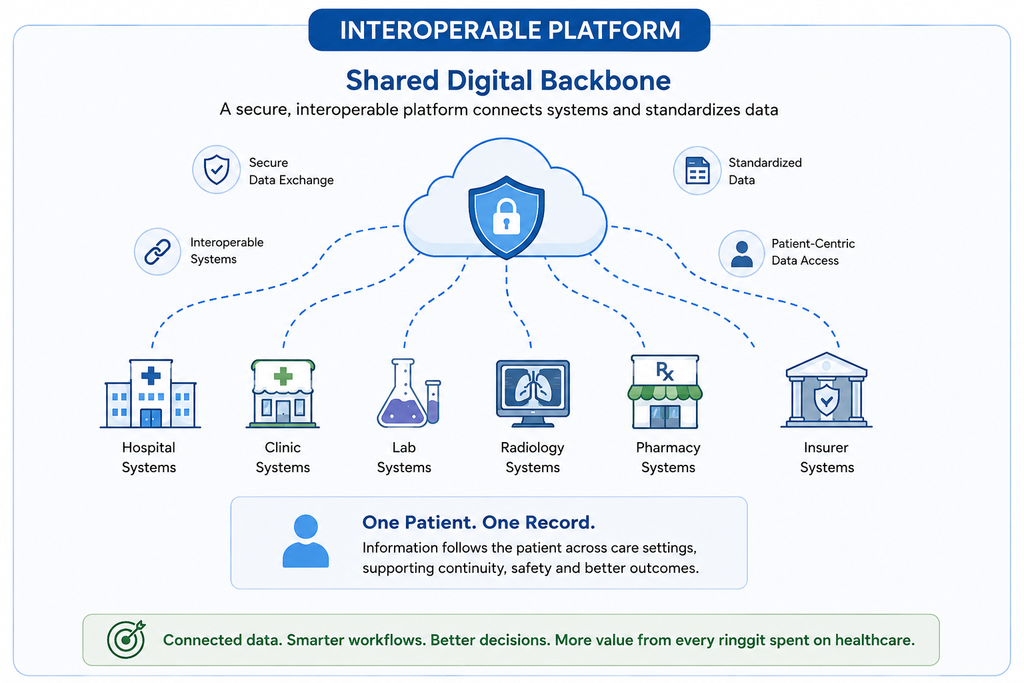
The potential economic return is substantial. A 2026 assessment by the OECD estimates that effective healthcare interoperability can yield annual value equivalent to 2.7% to 6.6% of total health expenditure. Applied to Malaysia’s RM84.2 billion health budget, interoperability could reclaim billions of ringgit in lost system capacity. However, the OECD emphasizes that these gains depend heavily on shared data standards, strong governance, high data quality, and user trust.
Digital tools also optimize how healthcare professionals spend their work hours. Streamlined digital workflows cut manual documentation and repetitive data entry, releasing clinical capacity for direct patient care. Yet, technology alone is not a silver bullet. Digitizing a broken process merely automates waste; workflow redesign must precede software deployment.
Shift from Activity Volume to Systemic Value
Connecting digital records unlocks structural insights that extend far beyond individual patient encounters. Aggregated, structured data allows health administrators to track real-time trends in patient demand, hospital utilization, wait times, and readmissions.
This capability marks a fundamental shift from recording healthcare volume to evaluating system performance:
| Evaluation Metric | Metric Focus | System Utility |
| Volume | Raw activity counts (surgeries performed, blood tests ordered, bed occupancy). | Measures short-term activity without evaluating care necessity or clinical impact. |
| Value | Resource utilization, complications prevented, long-term health outcomes relative to cost. | Identifies systemic bottlenecks, optimizes workforce deployment, and directs capital to high-impact care pathways. |
For a health system operating under tight fiscal constraints, this distinction is vital. It equips policymakers to allocate workforce and financial resources based on empirical population needs rather than static historical budgets.
Managing Chronic Disease and Financial Reform
The economic urgency of digitalisation becomes clearest in managing non-communicable diseases. Chronic conditions such as diabetes, hypertension, and cardiovascular disease require continuous care over decades, generating cumulative costs through endless consultations, lab tests, and medication updates.
Digital health cannot eliminate NCDs, but it fundamentally alters how the system manages them. Connected records ensure continuity of care across settings, remote monitoring tracks patient vitals from home, and predictive analytics flag high-risk individuals before complications occur. Because nearly 80% of Malaysia’s NCD cost burden stems from lost workplace productivity (RM51.8 billion), keeping chronic patients stable and out of emergency wards preserves both health budgets and economic output.
This infrastructure is equally vital for structural financing reforms. Under the joint RESET strategy, Malaysia is pushing toward Value-Based Healthcare (VBHC) and Diagnosis-Related Group (DRG) payment models to curb rising medical costs. VBHC rewards health outcomes achieved relative to money spent, moving away from traditional fee-for-service models that reward volume. Executing VBHC or DRG payments is impossible without clean, connected data that links clinical encounters, treatment costs, and long-term outcomes in a continuous loop.
Regional Benchmarks and Execution Risks
Despite the economic case, execution remains Malaysia’s central hurdle. Efforts to digitize public healthcare trace back decades, starting with computerized billing initiatives in the late 1980s and the 1999 rollout of the Total Hospital Information System (THIS) at Hospital Selayang. Yet by mid-2026, parliamentary updates revealed that only 22 public hospitals and roughly 510 primary clinics had cloud-based EMR systems installed, representing roughly 10% of the public healthcare network.
Regional comparisons highlight the operational challenges of scaling digital health:
- Singapore (National Electronic Health Record): Established in 2011, Singapore invested approximately S$660 million over more than a decade to build its central repository. Despite a small, centralized health system, voluntary adoption among private providers lagged, eventually requiring policy interventions and mandatory compliance legislation in 2024 to achieve full national integration.
- Indonesia (SATUSEHAT): Rather than replacing every legacy system across its archipelago, Indonesia introduced SATUSEHAT as an interoperability layer using open standards (HL7 FHIR). This allows diverse hospital and clinic platforms to exchange data without discarding existing IT infrastructure.
- India (Ayushman Bharat Digital Mission): India scaled rapidly via digital identity accounts, linking over one billion health records by 2026. However, field studies indicate that patient account registration numbers run ahead of active daily clinical use by healthcare providers, a distinction relevant to Malaysia’s facility rollout metrics.
Malaysia’s recent funding expansion accelerates project timelines, but rapid deployment increases structural execution risks. Fragmented procurement across different system tiers risks creating new digital silos unless common data standards are strictly enforced across all vendors.
Spending Better, Not Just Cost-Cutting
Digital transformation is frequently pitched as a fast way to cut healthcare expenditure. That expectation must be treated with caution. Digital health requires sustained capital outlays for hardware, cybersecurity, software licensing, system maintenance, and continuous workforce training.
The true economic return is productivity and allocative efficiency, not immediate cost reduction. Effective digital infrastructure eliminates redundant diagnostic testing and administrative overhead. It maximizes clinical staff capacity and facility resource utilization. Finally, it provides empirical data to direct health spending where it yields the highest clinical return.
The ultimate measure of Malaysia’s digital transformation should not be the number of software applications deployed or facility contracts awarded. Success must be judged by whether the digital backbone enables better clinical outcomes, reduces systemic friction, and delivers maximum health value from every ringgit invested.
References
Ministry of Finance Malaysia. (2026). RESET strategy. Government of Malaysia. https://www.mof.gov.my/en/reset
Ministry of Health Malaysia. (2026). Digital Strategic Plan Ministry of Health Malaysia 2026–2030. Government of Malaysia. https://www.moh.gov.my/en/publications-and-reports/policies-act-policies-guide-lines/strategic-plan/list-of-strategic-plans/digital-strategic-plan-ministry-of-health-malaysia-2026-2030
Bernama. (2026, August 31). Additional RM350 million brings MOH allocation to RM1 billion, accelerates EMR implementation. The Sun Malaysia. https://thesun.my/news/malaysia-news/people-issues/additional-rm350-million-brings-moh-allocation-to-rm1-billion-accelerates-emr-implementation/
Ministry of Health Malaysia. (2026). Malaysia National Health Accounts: Health expenditure 2011–2023. Government of Malaysia.
Ministry of Health Malaysia, & World Health Organization. (2024). Prevention and control of noncommunicable diseases in Malaysia: The case for investment. Government of Malaysia. https://www.moh.gov.my/moh/resources/Penerbitan/Laporan/Umum/NCD_Investment_Case.pdf
Ministry of Health Singapore. (2024, November 9). All private hospitals commit to enhancing health data sharing for more seamless care delivery. https://www.moh.gov.sg/newsroom/all-private-hospitals-commit-to-enhancing-health-data-sharing-for-more-seamless-care-delivery/
Ministry of Health Singapore. (2022). Expenditure on and utilisation of National Electronic Health Record system. https://www.moh.gov.sg/newsroom/expenditure-on-and-utilisation-of-national-electronic-health-record-system/
Ministry of Health Singapore. (2024, September 26). Speech by Mdm Rahayu Mahzam, Minister of State, Ministry of Health, at the Asia New Vision Forum. https://www.moh.gov.sg/newsroom/speech-by-mdm-rahayu-mahzam–minister-of-state–ministry-of-health–at-the-asia-new-vision-forum–26-sep-2024/
Ministry of Health Republic of Indonesia. (2022). Understanding SATUSEHAT. https://www.kemkes.go.id/eng/mengenal-pengertian-satusehat-2
Ministry of Health Republic of Indonesia. (2025). SATUSEHAT Platform. https://satusehat.kemkes.go.id/faq/platform/50c0fb80-1c3b-4bd2-bff1-119b51b96afe/apa-itu-satusehat-platform
Ministry of Health and Family Welfare, Government of India. (2026, May 22). 100 crore health records linked with ABHA under ABDM, marking major leap in digital healthcare. Press Information Bureau. https://www.pib.gov.in/PressReleasePage.aspx?PRID=2264241
Organisation for Economic Co-operation and Development. (2026). Interoperability in healthcare: Towards an interconnected future (OECD Health Working Papers No. 197). OECD Publishing. https://doi.org/10.1787/eb71b7be-en