


Executive summary
Malaysia’s non-communicable disease (NCD) burden makes prevention an economic priority. The opportunity for investors sits in accessible diagnostics, primary care that holds on to patients, and technology that lets providers show better outcomes. Employers, insurers and healthcare operators are the likely buyers of these services, since they carry the cost of chronic illness. The strongest proposition is a clinically credible, affordable care model with recurring revenue and a payer who has already been identified. Policy reform gives the market a push, but commercial success will depend on execution, on keeping patients engaged, and on evidence that earlier intervention is worth paying for.
A health burden with economic consequences
The cost of diabetes, cardiovascular disease, cancer and chronic respiratory illness goes well past hospital bills. It shows up in household income, in how many people can stay in work, and in what is left over for national development.
Malaysia’s MOH–WHO investment case, released in 2024 using 2021 data, put the annual NCD burden at RM64.2 billion, or 4.2% of GDP. Of that, RM12.4 billion was government healthcare spending and disability payments, and RM51.8 billion was lost productivity. This is an economy-wide burden estimate. It is not a healthcare budget requirement, and it is not a commercial market size.
The clinical need is large. NHMS 2023 found diabetes in 15.6% of adults, hypertension in 29.2% and high cholesterol in 33.3%; 54.4% were overweight or obese. About two in five adults with diabetes did not know they had it. That gap is where earlier detection, tied to follow-up that actually happens, can do the most.
Connecting detection to care
Prevention covers avoiding disease, finding it earlier and limiting complications after diagnosis, so the technologies involved run from diagnostics to monitoring to care coordination.
Continuous glucose monitors show the shift towards more continuous information. A small sensor under the skin estimates glucose in the fluid between cells, picking up patterns that occasional measurements miss. Readings can be sent to connected devices and shared with clinicians to guide management.
Diagnostics are also getting easier to reach. In May 2025 the US FDA authorised the Teal Wand for collecting vaginal specimens at home for validated molecular testing for human papillomavirus (HPV). The lab testing and clinical follow-up stay where they were; what changes is where the sample is taken. That is a commercial opening to cut the practical barriers to screening.
The bigger opportunity is to link these tools to medical records, risk assessment and accountable care teams. Software can flag a worrying result and organise the follow-up, but the clinical judgement still has to come from a person. Investors should look at the whole pathway: does the patient get an accurate result, turn up for the next appointment and receive the right care? More data is worth something only when it changes decisions and outcomes.
Market size and growth
Malaysia’s own spending is the place to start. The table separates the whole health economy from the narrower preventive-care accounting category.
| Malaysian expenditure indicator | 2019 | 2024 |
|---|---|---|
| Total health expenditure | RM64.09 billion | RM89.83 billion |
| Preventive care, including drinking-water interventions | RM4.24 billion | RM5.42 billion |
| Preventive care as a share of total expenditure | 6.6% | 6.0% |
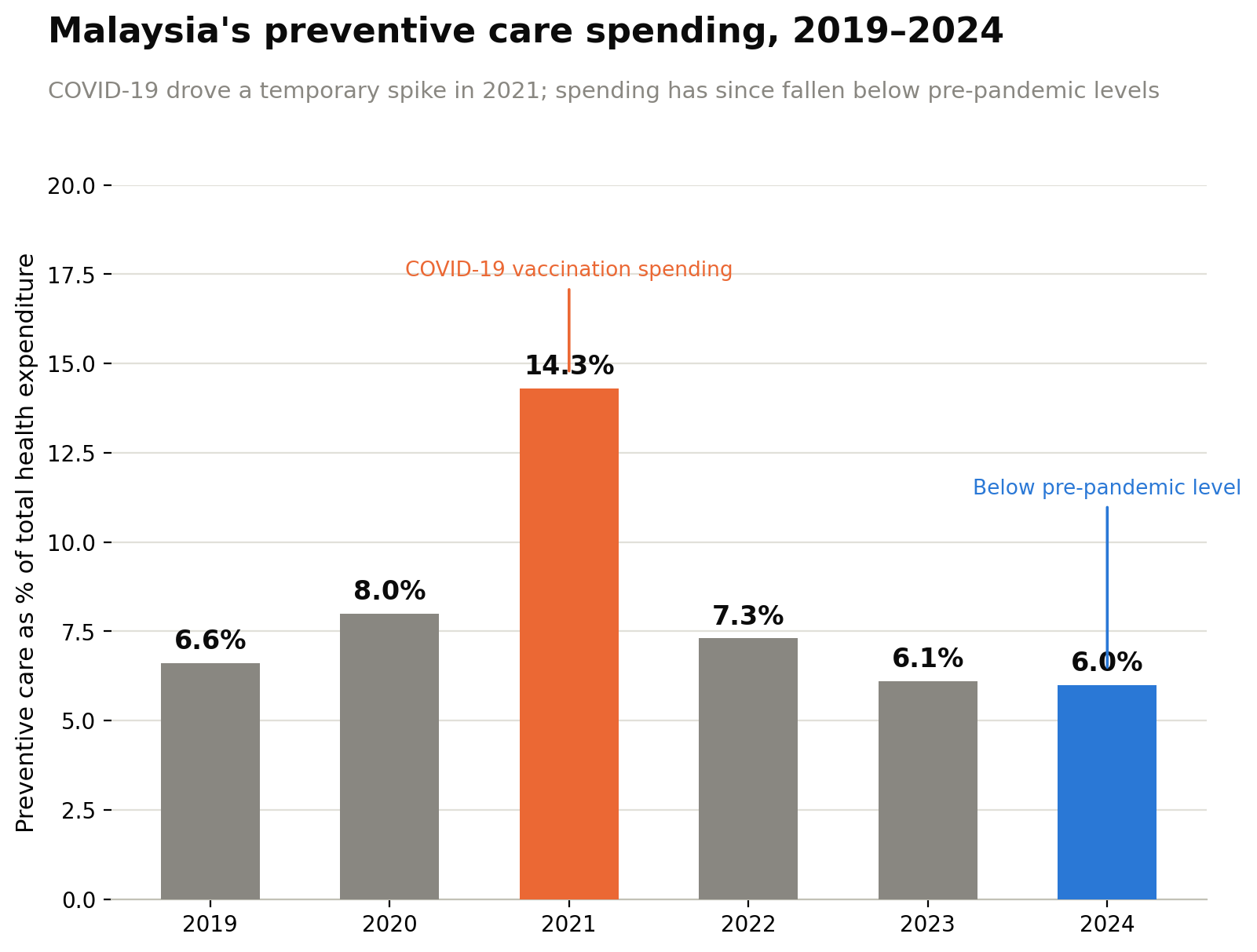
Amounts are nominal. Worked from the underlying figures, total expenditure grew about 7.0% a year over 2019–2024, against 5.0% for preventive care. Prevention’s share fell even as the ringgit amount rose. The category also covers more than NCD prevention, and it leaves out some individually delivered services that are booked under curative care.
Globally, Grand View Research puts the digital health market at US$347.4 billion in 2025, forecasting US$420.2 billion in 2026 and US$1.83 trillion by 2033, a 23.4% CAGR over 2026–2033. North America was 37.1% of 2025 revenue, and Asia Pacific is forecast to grow fastest. These are commercial research estimates covering a broad technology ecosystem, including services well beyond prevention.
A credible Malaysian total addressable market (TAM) has to be built up from eligible patients or organisations, achievable annual revenue and reimbursement eligibility. Prevalence tells you the need; adoption and payment tell you the market you can actually get. National spending, productivity losses and global technology forecasts should never be added together.
Policy, financing and delivery reform
The Thirteenth Malaysia Plan, covering 2026–2030, puts healthcare reform and health-information sharing into the national development agenda. Its proposed digital platform for exchanging information across public and private providers gives a policy reason for interoperable systems. How fast that turns into commercial demand depends on implementation and procurement.
Financing reform is further along. Bank Negara Malaysia describes a July–October 2026 pilot for MediAsas, the standardised base medical insurance and takaful plan, ahead of a planned national rollout in January 2027.
The framework around it moves in phases towards diagnosis-related group (DRG) payments, which pay providers for clinically comparable care episodes. That creates demand for reliable coding, costing and clinical data. Fixed episode payments on their own do not reward prevention, so purchasers will also have to design incentives for continuity, quality and appropriate care.
Singapore’s Healthier SG is a useful reference point. It links enrolled residents to a regular primary-care clinic and a personalised health plan. What matters for Malaysia is the continuity of that relationship, and the way screening sits inside ongoing care.
The US shows that savings can fund provider incentives. Medicare’s Shared Savings Program reported US$2.5 billion in savings against benchmarks for 2024, alongside US$4.1 billion in performance payments to participating accountable care organisations. That is reason enough to test aligned incentives here, with realistic expectations about how well the model travels.
Where commercial value can emerge
Integrated diagnostics and patient navigation is the first area. Screening businesses are worth more when they carry the patient from the test through to confirmatory diagnosis and referral. Revenue can come from testing contracts and from care-coordination services sold to employers, insurers and provider networks. Diligence should cover diagnostic accuracy, referral completion, affordability and local regulatory requirements. High test volume without follow-up is a weak base for either impact or lasting differentiation.
Chronic-disease management sold to institutional purchasers is the second. Services that combine monitoring, clinician access and structured support can be bought on subscription or per enrolled member. Employers are a distribution channel; insurers may pay for better management of the populations they cover. Contracts should keep clinical improvement separate from demonstrated financial savings, and allow for participant risk, attrition and the time it takes for benefits to show.
The third is infrastructure for coordinated, accountable care: interoperable records, laboratory connectivity, DRG coding and outcomes measurement, sold as recurring software and services. Defensibility comes from reliable integration, clinical usability and customer relationships that last. Malaysia can serve as a development and validation base for ASEAN expansion, as long as the business adapts to each country’s payment system, language and regulatory requirements.
For Xeraya’s investment lens, the common test is evidence that a solution can scale economically. Useful milestones are patient retention, clinician workload, cost per completed care pathway and customer renewals. Funding should track clinical validation and commercial adoption, with enough capital to get through integration and procurement cycles.
Making prevention investable
Malaysia’s NCD problem is a long-term reason to improve prevention and continuity of care. The investment case estimates that selected interventions could recover RM30 billion in economic output and save more than 180,000 lives over its modelled 15-year horizon. Those are societal benefits, not investor return projections.
For private capital, the job is to build businesses that last inside that opportunity. Reimbursement uncertainty, workforce constraints, data protection and uneven adoption are all real risks. The investments worth making are the ones that make good care easier to get, show who benefits and name who will pay.